
Straight answers
Texas window tint law
What's legal, what's not, and what we'll tell you before we cut a thing. Current for 2026.
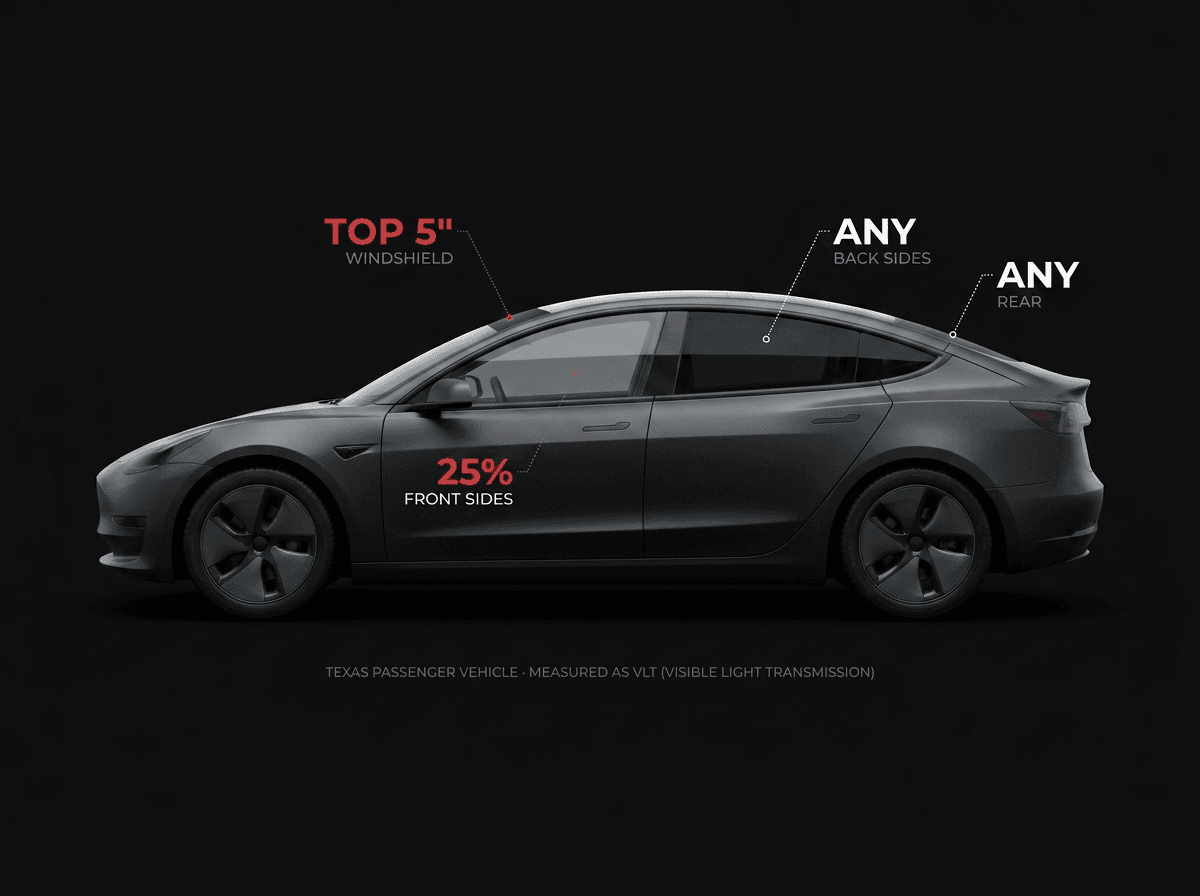
01 / The limits
- Front sides25%must let in more than 25% of light
- Back sidesAnyany darkness allowed
- Rear windowAnyany darkness with side mirrors
- WindshieldTop 5"strip above the AS-1 line only
02 / How dark is what
Every percentage, side by side
Lower number, darker glass. Front sides must pass more than 25%. Below that line is back-glass only.
5%
Limo
Can't see in. Can barely see out at night.
Back glass only
15%
Dark
The look most people picture.
Back glass only
20%
Standard dark
The common pick for back glass.
Back glass only
35%
Factory-ish
Close to a truck's factory rear tint.
Legal up front
50%
Light
Heat control without the look.
Legal up front
70%
Near clear
Ceramic heat rejection, barely visible.
Legal up front
03 / Try a darkness
See what's legal before you pick
35% VLT
- Front sides
- Legal
- Back sides & rear
- Legal at any darkness
Texas requires front side windows to let in more than 25% of light. Lower VLT = darker film.
The law
How much does tint cost in Georgetown?
Window tint at Shade Customs starts at $249 for a full car in 3M Color Stable. 3M Ceramic IR runs $649 and 3M Crystalline starts at $899. Those are sedan prices, so a three-row SUV or a minivan carries a size adder, and a front-two-only job starts at $129. We're a 3M authorized dealer and 3M is the only film we install, so those three numbers are the whole menu. Build the exact car on the auto tint page, then pick your exact time on our live booking calendar. No surprise add-ons at pickup.
What's the legal tint limit in Texas?
Texas law requires front side windows to let in more than 25% of light; back side and rear windows can be any darkness. The windshield can only be tinted above the AS-1 line, or the top 5 inches. We install to these limits by default and will tell you straight if a request isn't street-legal.
How long does an install take?
Most cars are in and out the same day, usually 2 to 3 hours for a full vehicle. Drop off in the morning and you're out by 5:30. Film cures fully over the next few days; we'll tell you when it's safe to roll the windows down.
Ceramic vs carbon, worth it?
Worth it, and here's the honest version rather than the sales one. On 3M's published numbers the two are closer on TOTAL heat than most shops admit: at 35% up front, Color Stable rejects 57% of total solar energy and Ceramic IR 58%. Where they genuinely separate is infrared — the part 3M says is primarily responsible for the heat you actually feel through the glass. At that same 35%, Ceramic IR takes out 85% of it and Color Stable 32%. So it's not that carbon doesn't work; it's that ceramic pulls the radiant heat off your arm and your dash rather than just cutting the light. Ceramic IR also carries the Skin Cancer Foundation's Seal of Recommendation, which Color Stable doesn't. If you're going dark and the car sleeps in a garage, Color Stable is honest money. Both are 3M and both carry 3M's lifetime warranty and ours.
Is there a medical exemption?
Yes. Texas allows darker front-window tint with a signed medical exemption statement from a physician or optometrist. Bring the paperwork and we'll install to the exemption. Without it, we keep front sides at the legal 25% by default — but if you want it darker up front anyway, we'll install what you ask for. The choice is yours, and so is anything a trooper has to say about it.
What's the warranty?
Two warranties, and you get both. 3M warrants the film itself for as long as you own the vehicle — cracking, crazing, bubbling, delamination, and colour change, including the purple that kills cheap film. On top of that we warrant the workmanship for life, in-house at the shop on University Ave, so a lifted edge or a stray speck is handled here rather than by a mail-in process. Being a 3M authorized dealer is what makes the first of those two possible.
Can I tint my windshield in Texas?
Only the top strip. Texas allows film above the AS-1 line, the small marking near the top of most windshields, or the top 5 inches if there's no AS-1 line, and it can't be red, amber or metallic-reflective. The rest of the windshield stays clear. A clear or near-clear ceramic across the full windshield is a different product and a different conversation; ask us.
Do I have to remove old tint before new tint?
Yes. New film will not bond over old film. It has to go down on clean glass, so the old layer and its adhesive come off first. We do the removal here and can re-tint the same visit. Full detail on the tint removal page.
The film
Tint basics
What does VLT mean?
VLT is visible light transmission. The percentage of light a window lets through. 35% VLT means 35% of the light gets in, so a lower number is a darker window. Every tint law and every film spec is written in VLT.
What tint percentage should I get?
For most cars: 35% on the front sides is the practical pick, since Texas requires more than 25% there and 35% gives you margin. Back sides and rear can go as dark as you want: 20–25% is the common choice, 5% is limo. If heat is the reason you're tinting, pick the film grade first and the darkness second.
Does tint keep the car cooler, or just darker?
Cooler, but darkness isn't what does it. Infrared rejection is. A light ceramic film blocks more heat than a dark carbon one: 3M Ceramic IR at 50% rejects about 83% of infrared while Color Stable at 20% manages about 68%, and the Color Stable is far darker. If the goal is a cooler car rather than a darker look, spend on the film grade and pick the shade second.
Will tint block my phone signal or toll tag?
Nothing we install will. Older metallic and some hybrid films can interfere with cell, GPS, radio and toll tags because they contain actual metal. All three films we carry — 3M Color Stable, 3M Ceramic IR and 3M Crystalline — are non-metallized by design, so signal passes through them normally. 3M states that explicitly on all three product bulletins.
How long before I can roll the windows down?
Give it two to three days in Texas summer, longer in winter. The film is cut and squeegeed the same day but the adhesive needs to cure, and rolling a window down early can drag the edge. Some haze or small water pockets in the first few days are normal and clear on their own.
General information, not legal advice. Rules change; the Texas Department of Public Safety is the authority. We'll tell you if a request isn't street-legal.